

UNDERSTANDING THE OPTION OF THE CROSS
A TRIP TO FIND HOPE AMONG THE POOR
 GUERRERO, Mexico – At 2 a.m. on Monday morning, we set out for Acatepec, deep in the mountains of Guerrero. The road was all dirt, narrow, steep, rutted, and washed out in more places than not. I was traveling with two sisters of The Sisters of Mary. The road did not deter them. They never mentioned the treacherous journey.
The State of Guerrero in Mexico is treacherous for other reasons as well. Guerrero is the second poorest state in Mexico. Two-thirds of families live in poverty. The poverty is alarming and debilitating for families. Drug trafficking and human trafficking are pervasive. Insecurity and violence are a part of life growing up there, especially in remote villages.
It was here that I was able to meet Martina Alphonso and her two daughters. Their father abandoned them years ago. Martina earns about 100 pesos (about $4) per day cleaning houses. Almost half of Martina’s income goes to the landlord of her plot of land, where she has constructed a home of fabric walls, a tin roof and a hard packed dirt floor. Her daughter, Marie (11) is a good student, but she has not been in school since the pandemic started one year ago because they have no cell phone and no access to the internet to attend classes remotely. Martina wants more for her daughters.
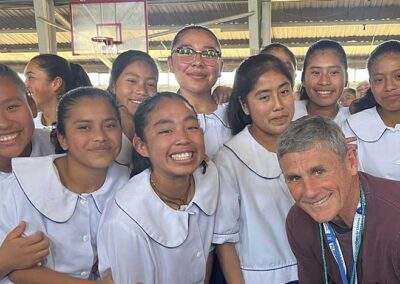
 Many times throughout the year, The Sisters of Mary travel, two by two, throughout Mexico to find the poorest of the poor like Marie and her family. I was able to accompany The Sisters of Mary in my role as executive director of the Sister’s U.S. mission development office headquartered in Annapolis.
In considering whether or not to attend the recruitment opportunity with the Sisters, I certainly took into account the pandemic – my own health, the risk to my family, and the risk I was putting the Sisters and children in by traveling down to Mexico. Finally, I thought about as the height of privilege that I even had a choice. The Sisters know they fail their calling if they cannot do their work reaching out to the poor face-to-face. The poor we encountered have little choice about their circumstances without opportunities like those that the Sisters are offering. I was the only one with a choice. Accompanying the Sisters and the poor was an easy choice to make in that light.
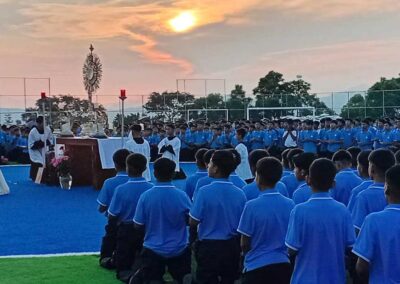
The Sisters of Mary work in Asia, Latin America and Africa, seeking impoverished children who have completed elementary school, and inviting them to come to their Girlstowns or Boystowns for secondary and high school education. This education proves life changing for students, helping to give them the tools they need to break free from the cycle of poverty. In the past 60 years, over 150,000 children have graduated from The Sisters of Mary schools and gone on to improve their lives and help their family and communities.
There are scores of governmental programs and non-governmental organizations with programs meant to benefit the poor in Guerrero, but poverty relief programs here are notoriously unsuccessful and unsustainable.
The Sisters of Mary present another option – the Cross – constant in its application and novel in its presentation. The Sisters do not come to the region with a program or experiment, but with a challenge. Not innovative ideas, but deep and difficult conversation, penetrating questions and rousing propositions. It is difficult work. It takes time.
By day two, I almost passed out from the food, the heat, the work and the elevation. These simple, small and smiling Sisters, in their full habits, never paused.
CASTING OUT INTO THE DEEP
“Why do you want to come study at the Boystown in Guadalajara?”
“Do you know that it is very far away?”
“Won’t you cry because you won’t be able to see your mom for an entire year? Won’t you miss her?”
The children don’t have all the right answers – as I’m sure would be the case for most of us at 11 or 12 years old. In fact, these questions are met more with silence than any other response. However, the Sisters have had thousands of these conversations. They know that ready and rehearsed answers are generally not the truth.
 Sr. Margie asked Marie, “Why do you want to study at the Girlstown in Chalco?” Marie was silent.
Sr. Margie asked Marie, “What do you want to be when you grow up?” Marie shrugged her shoulders and started crying.
She’d never thought about dreaming. She finally said she simply trusted Carmen, the woman who brought Marie to the attention of the Sisters. That was enough. Trust in a friend.
Drawing the children into understanding the difficult road ahead is why the Sisters are probing. Transformational education is a wonderful opportunity, but to be effective, the Sisters know, it comes at a cost. In the Girlstowns and Boystowns, the children will face crosses of loneliness, challenging studies, strenuous cleaning, uncertain outcomes, and the discomfort of learning things anew. Life afterward is even more arduous, combating the culture, finding work, and serving others in the same way the Sisters have served them.
Rather than replace the Cross of Christ with a feeble and fleeting social commitment to the poor, the Sisters mission is to bring impoverished children to the Cross. Teach them that the Cross is worthy of their kiss and embrace. Demonstrate for them, that the depth of life, love, beauty is found in the Cross and the wounds it imparts.
 After discernment, the Sisters will let the students know in May if they have been accepted. Hundreds more children apply than spots available. All are poor, by our standards, but the Sisters must seek out the poorest of the poor with the greatest need and greatest potential to bring their families and communities out of poverty in order to do the most good with limited resources. By the grace of God, more vocations and support from higher-income countries will expand the work. The need far outpaces support for these unglamorous efforts.
New students will then be welcomed to Girlstown or Boystown in August to begin their time with the Sisters – usually 5 years, year-round, with two visits home per year in the summer and at Christmas. By the grace of God, Maria will join the Sisters and 3,000 other girls working to break free from poverty in Chalco Girlstown this August.
FAR BE IT FROM ME TO GLORY EXCEPT IN THE CROSS
In the Catholic Church in America we face many perils, some the same as lower-income countries, many different. Internal divisions and external disgust will keep the Church from being ‘popular’ again for at least a generation, likely longer. Yet the Church, properly understood and oriented, is broader and deeper than our contemporary ecclesial malaise.
Hope is found at the foot of the Cross, bearing the Cross, embracing the Cross. Often embarrassing and full of persecution, it is difficult work. It takes time.
This is what The Sisters of Mary taught me on our short trip together. Inquiring into another’s life and proposing a beautiful way forward, even if it is the way of the Cross, provides mutual recognition that Christ dwells here with us. Accompanying each other to the foot of the Cross to hear the final pleas of Christ is where we find direction and hope.
Marie is the future of the Church because she knows the Cross. The Sisters of Mary will help her understand that there is mercy and love in that very same Cross she already knows so well. If we desire the best future for the Church – it will be found through the Cross, not in spite of it – entering into the poverty of Christ and letting Him love us in our poverty.
Paul Gesterling is the President/CEO of World Villages for Children, the U.S. support office for The Sisters of Mary, an international religious congregation dedicated to serving the poor through education.